Jeff Koons on curiosity, caring, and sending art to the moon.
At IST Festival 2025, artist Jeff Koons joined moderator Timothée Verrecchia for a wide-ranging conversation about wonder, science, the ethics of making, and what it means to keep becoming — as an artist, and as a human being.
VERRECCHIA
Istanbul seems to have gotten under your skin. What is it about this city, and more broadly — how do you maintain that state of wonder? You move through the world with an appetite that most people lose over time.
KOONS
I try to stay open to everything. What pulled me to the art world was to be able to be part of a group — the avant-garde — in an intimate environment and in dialogue about possibilities. I’m interested in the possibilities for myself to become, and the possibilities that we all can become as a group. I’ve developed a practice of removing judgment — just the acceptance of everything. Certain things at certain moments may feel more relevant to me than others, but that doesn’t make what I’m not looking at any less important. Everything is perfect in its own being.
VERRECCHIA
How do you find the energy and focus? We’re so solicited by constant information, constant opportunities, constant options.
KOONS
The American philosopher John Dewey speaks about life experience and the art of experience. He describes communication at the most basic level: how a single-cell organism is transformed by its environment, and then transforms it in return. That’s my basic model. The internal communication with the self, and then that relationship with the external world. Being open to things, engaged with things, reflecting on things — letting the information come in. That transforming experience is where you continue to become as an individual. I try to be open to the colors I see, the forms, the context something is in. That engagement keeps me curious. All experience, all feeling, all knowledge — it’s there at our disposal, if we let it be. But if we segregate, if we make judgment, we’re eliminating our possibilities — distancing ourselves from incorporating these elements, these experiences, these feelings, these symbols into our own communication.
VERRECCHIA
How do you decide what you bring back into your work? I see you absorb places, people, history. How do you filter?
KOONS
That enters a kind of moral range. From life experience — what you hold dear, how you view yourself, your needs alongside the needs of others. I want more experience, I want stronger sensations, I would like to have more knowledge — I want to become a better person, a greater being, a better artist. But I also want to share that becoming. When I use the word morality, I mean how you see yourself, your growth, and wanting others to experience it too. There’s a balance between your own needs and the needs of the community. That’s what guides the filtering. The love of that balance.
VERRECCHIA
You’ve spoken about the importance of contextualizing your work within your lifetime — of being present for the narrative.
KOONS
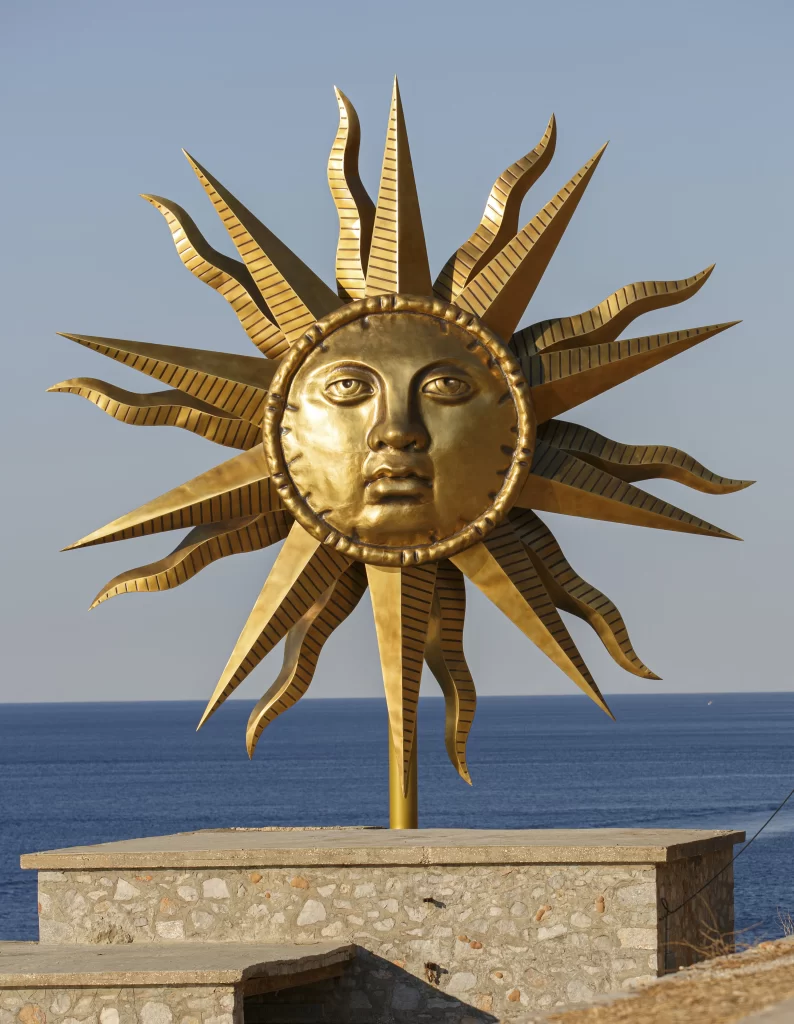
I’ve always enjoyed creating narratives. I’ve found that if you stay open to what genuinely interests you, if you follow your curiosity and focus there, it connects you to a universal vocabulary. You start to realize the abundance of that information — how you’re surrounded by it — and you find the interconnections it has to the rest of knowledge. When I focus on a body of work, it takes me to where things interconnect, and I’ll hopefully be revealing a vocabulary that already exists within that grouping of objects, images, information.
VERRECCHIA
Science seems to be a constant thread in your practice. Most artists treat technology as an endpoint: the thing that produces the work. For you, science runs through everything you do — more like a dialogue partner. Where does that come from?
KOONS
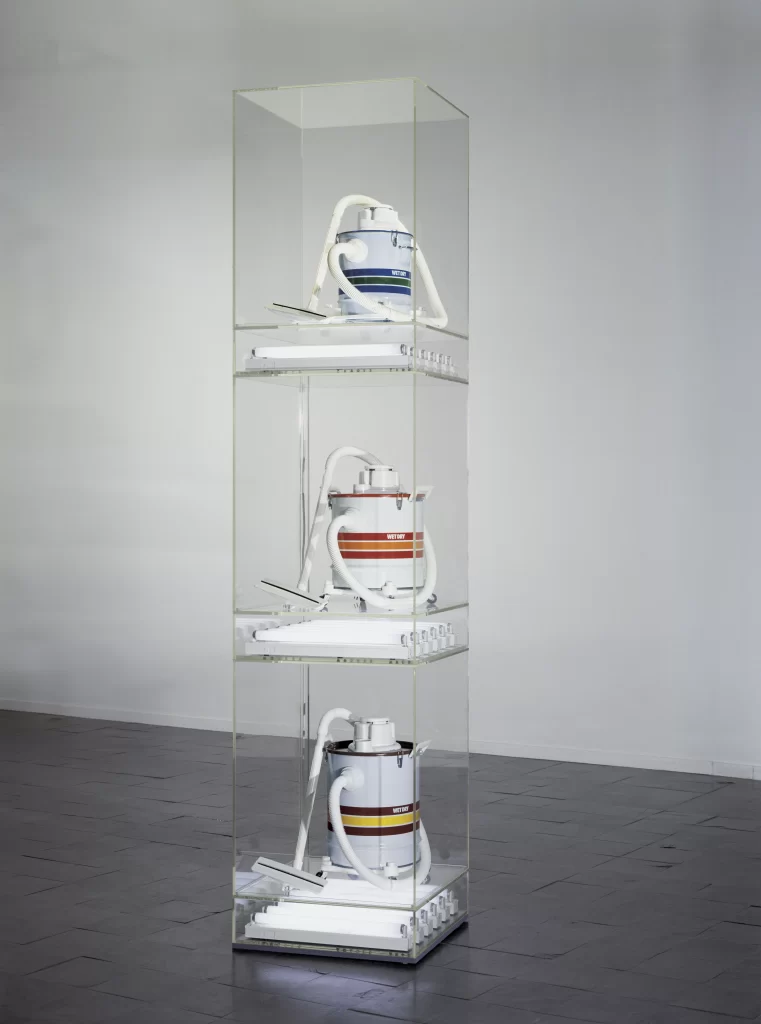
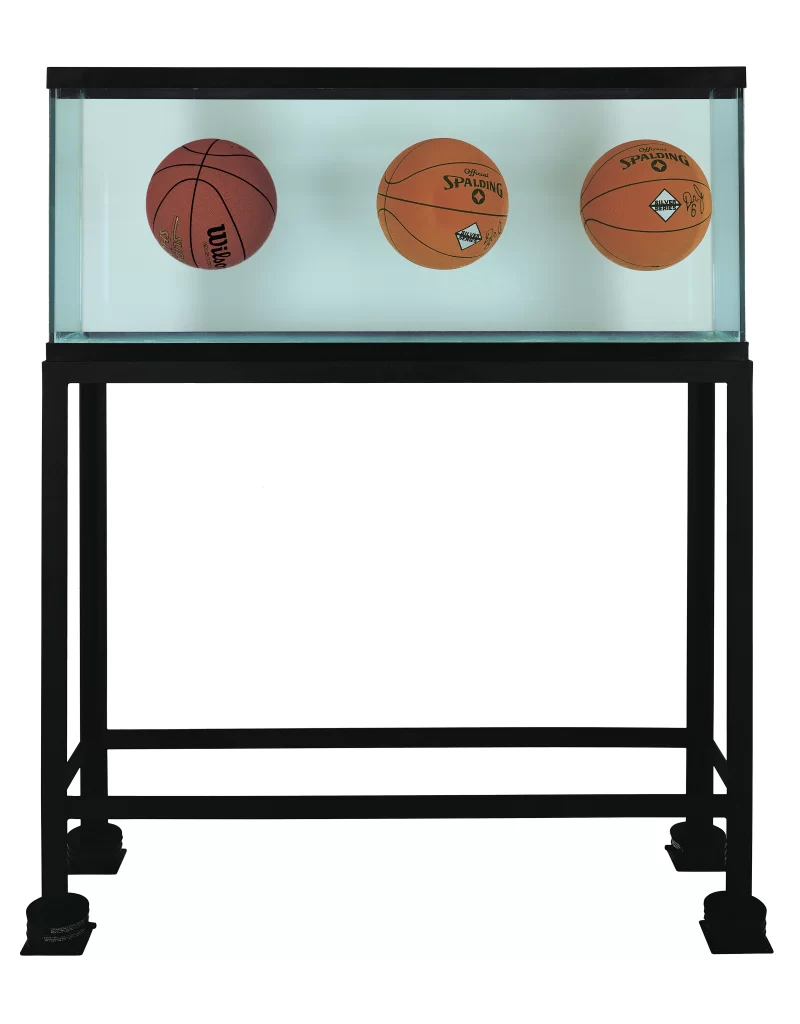
The sciences represent the external world — working with it, understanding it — and I’m always trying to find the relationship with the internal world, that balance back and forth, the unifying aspects of it. When I started my New series in 1979–1980, those objects — vacuum cleaners in lit vitrines — were directly confronting our biology. Then with the equilibrium works, basketballs hovering in tanks of water, I started reaching out deliberately to scientists. I contacted Richard Feynman, the Nobel Prize laureate for quantum dynamics. I’d read that he was also a painter, that he loved art. So I reached out. The sciences and the arts aren’t separate conversations: they’re part of the same one.
A lot of artists make the mistake, especially in their youth, of thinking that if they use the newest technology, their work will be new. But what people really want is something ancient — something that makes them feel the blood pump through them. People are seeking something very ancient. That’s what’s new: experiences that remind them of what life is.
VERRECCHIA
Much of the innovation you pursue is specifically about duration: making sure the work can exist in the world over time.
KOONS
It’s about responsibility. Everything goes to dust eventually — even the most durable materials. But that still gives us an opportunity to care. Technology, in my practice, is always in service of that care. How do we make something that can truly be of service to someone 200 years from now?
We’ve talked about our admiration of Steve Jobs. Walter Isaacson’s biography recalls a moment when Steve is in the backyard with his father, and his father tells him they’re going to paint the fence — and that it’s important to paint both sides, not just the side they’ll see from their home, but the side the neighbor will see. That type of caring — forget about aesthetics, forget about everything. The most important thing is to care. If you care about something, everything else comes along. A sense of morality comes through caring. Everything is based on just being thoughtful about something.
I understand that everything goes to dust. But that still gives us an opportunity to try to care. If you can be generous in some manner, just to one individual — it’s the same within the arts of trying to create something that can communicate to somebody, that can serve them in some way, create a shared human experience. That’s the work.
VERRECCHIA
That constant dance between creativity and innovation — when does it end? How do you know when you’ve reached the end?
KOONS
I have to smile. Some works have been 25 years — Play-Dough took 25. But I believe things should flow much faster than that. You can have the idea of something, you can envision it, but bringing it into reality takes time. I strive for the path of least resistance, but I also have a commitment — there’s one shot at this. I’d rather move vertically, into new territory, than horizontally, repeating the same idea. I try to use technology to help me move quickly. It’s intuitive: I focus on something that interests me, and before I know it, it’s taken me to a certain area. Not exploiting technology for its own sake — much more intuitive — but trying to amplify that vision as much as possible.
VERRECCHIA
Can you speak more about what you mean by vertical versus horizontal?
KOONS
Horizontal would be a constant repetition of something — making the same paintings over and over, with mild variations, circling one idea. I prefer to explore different areas entirely. Being here in Istanbul, going to the National Museum of Archaeology — I’ve seen the collection before, but looking at it again I thought: how have I not taken advantage of all the opportunities, all the beauty in the world? It’s overwhelming. How many lifetimes would you need? There’s real joy in recognizing that beauty, but also a kind of ache — the loss of everything you haven’t yet had the chance to absorb.
VERRECCHIA
Which brings us to the moon. You mentioned your work that went to the moon. Can you speak to that?
KOONS
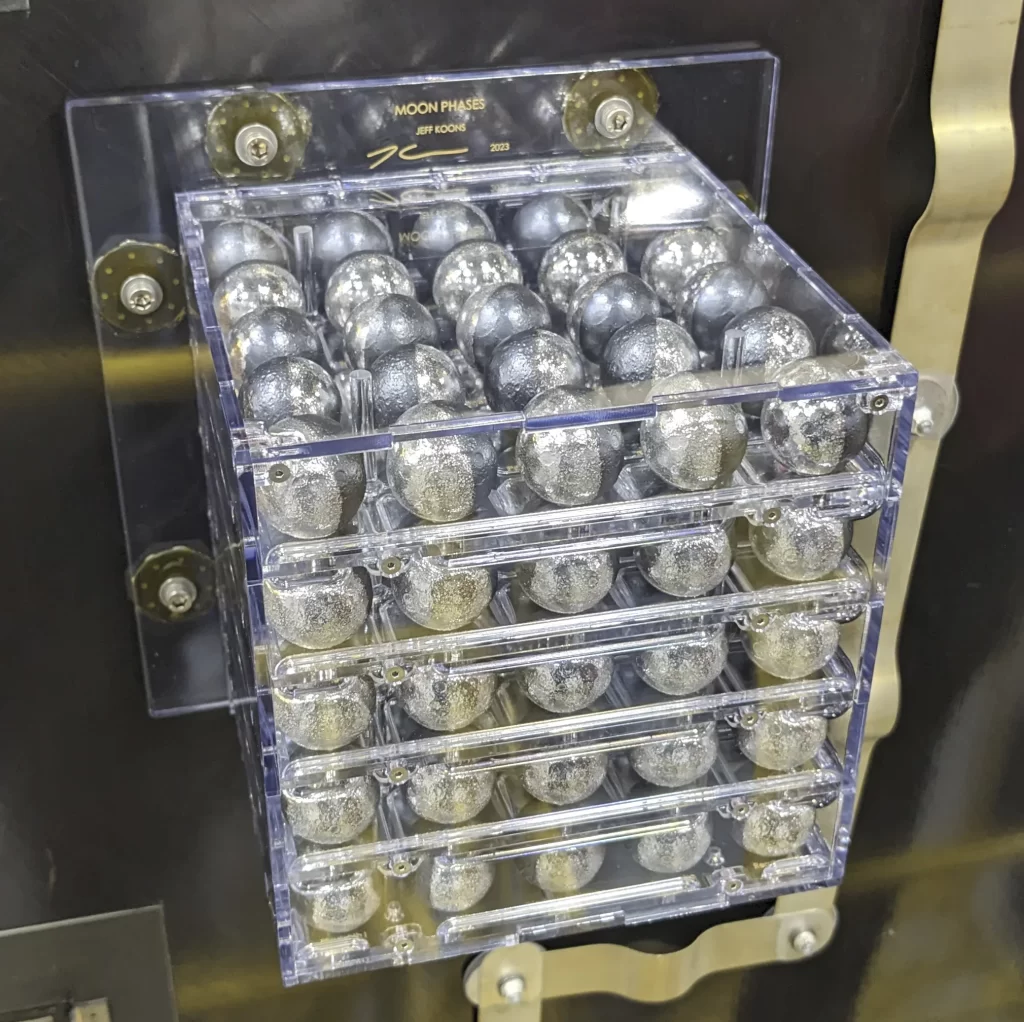
I sent work to the moon about a year and ten months ago. My son Sean, who went to the University of Chicago, met someone there who said: please show this project to your father. So Sean brought it to me. At first I wasn’t sure it would be reliable, but I looked into it — this was an opportunity to work with SpaceX and Intuitive Machines, whose largest payload was NASA. I decided to participate.
As far as working with technology and engineering, this was a wonderful opportunity. I had to design something that could absorb all the forces of launch, survive the temperature swings on the moon — over 400 degrees between sunlight and shadow — and look exactly the same 200 years from now. The polycarbonate, the coloring systems, the laser treatments, the stainless steel — everything had to be engineered for eternity. It made it in perfect condition.
VERRECCHIA
I’d love to end on the theme of the festival: What is really real? Knowing that things decay — what represents reality on a day to day basis? What do you think is really real?
KOONS
I think the interaction with oneself and with the environment. At a Nobel Laureate Week in 2014, I met Eric Betzig, and he told me: life is just a chemical, animated chain reaction. I thought: that’s beautiful. That’s exactly what it is. My fingertips are tingling. It’s just a chemical chain reaction, but it’s the animation of it — one chemical reaction against another, creating sensation. That’s life. That’s who we are. And this is how we have feelings, sensations, and this interaction with the world. I like to think about trying to keep those chain reactions flowing, celebrate them, enjoy them.
AI is amazing — I’m so appreciative of everything that comes with it. But AI doesn’t have the ability to fear death or to experience joy. It can simulate feelings, but it doesn’t know joy, and it doesn’t know fear. We do. I hope that we can learn to experience our senses on a higher level. In a way, we feel challenged by AI to do that — to really define what this biological experience is.